
The best legal drama movies transform arguments over evidence, guilt, and responsibility into gripping human stories. A jury can question a seemingly obvious verdict, a lawyer can risk a career for an unpopular client, and an ordinary family can discover that justice is not always the same as the law. The most memorable films in this genre offer more than a dramatic closing speech: they make us think about who gets heard and how decisions are made.
For readers looking for thoughtful movie recommendations on NetShort, this Top 40 guide combines celebrated Hollywood courtroom classics with legal thrillers, civil-rights stories, workplace cases, and international films from India, Argentina, France, and Lebanon. Expect actors including Henry Fonda, Gregory Peck, Denzel Washington, Michael B. Jordan, Sandra Hüller, and Nicholas Hoult in stories driven by difficult choices.
The list includes both trial-centered courtroom dramas and legal dramas that follow investigations, negotiations, or appeals outside court. Some films draw on real cases but dramatize events, so they should not be treated as legal instruction or complete historical records. Several involve sexual violence, discrimination, death, or disturbing testimony. Films are grouped by storytelling style instead of presented as an official ranking, and the descriptions avoid revealing final verdicts.
What Makes a Great Legal Drama Movie?
The best legal drama movies create tension from what can be proved, not merely from what the audience suspects. A compelling case combines procedural obstacles with a genuine human cost, giving lawyers, witnesses, jurors, and defendants competing reasons to act.
- High-stakes conflict: A contested conviction, family custody battle, corporate lawsuit, or constitutional right affects real lives.
- Evidence and uncertainty: Testimony, cross-examination, and reasonable doubt challenge first impressions.
- Ethical dilemmas: A lawyer’s duty to a client can conflict with reputation, career, or personal beliefs.
- Social context: Prejudice, power, money, and access to representation often influence the legal process.
- Different rhythms: Quiet jury-room conversations can be as suspenseful as conspiracies and courtroom confrontations.
Classic Courtroom Dramas That Defined the Genre
Early legal films established the suspense of witness testimony, moral debate, and the difficult distinction between legality and fairness. These eight classics are ideal for understanding the best legal drama movies and the questions later filmmakers continue to revisit.
1. 12 Angry Men (1957)
- Director: Sidney Lumet
- Style: Jury-room drama
- Key highlight: One dissenting juror forces a serious debate about reasonable doubt
A young defendant faces a murder conviction, and almost every juror seems prepared to vote guilty. Henry Fonda plays Juror 8, who asks the group to reconsider details of the evidence instead of rushing to a decision. Sidney Lumet keeps almost the entire film inside a deliberation room, where personalities and assumptions become as important as the original testimony.
The absence of a conventional courtroom makes the film more striking, not less legal. We watch how confidence, class prejudice, irritation, and patient questioning influence twelve people with an enormous responsibility. Choose it if you want concentrated dialogue and a powerful demonstration of why the burden of proof matters.
2. Witness for the Prosecution (1957)
- Director: Billy Wilder
- Style: British murder-trial mystery
- Key highlight: A celebrated barrister defends a man facing a murder charge
After recovering from serious illness, barrister Sir Wilfrid Robarts returns to work and becomes involved in the defense of Leonard Vole, accused of killing a wealthy woman. Charles Laughton plays the sharp, stubborn lawyer, while Tyrone Power and Marlene Dietrich inhabit a story where personal loyalties and courtroom testimony are difficult to separate.
Adapted from an Agatha Christie work, it builds suspense through contradictions and carefully staged revelations. Wilder also allows moments of dry humor to emerge from the lawyer and his nurse. Avoid detailed plot summaries before watching, since discovering which claims to trust is the main pleasure.
3. Anatomy of a Murder (1959)
- Director: Otto Preminger
- Style: Detailed criminal courtroom drama
- Key highlight: A defense lawyer constructs a challenging murder case
Former prosecutor Paul Biegler agrees to defend a soldier accused of killing the man he believes assaulted his wife. James Stewart portrays Biegler without the uncomplicated certainty associated with many screen heroes. Much of the movie follows conversations about the evidence, the client’s potential defense, and the uneasy distinction between legal strategy and personal conviction.
Its unusually patient treatment of questioning and trial procedure makes it rewarding for viewers curious about how attorneys shape a case. The subject involves sexual assault and adult language, and the truth remains harder to pin down than an idealized courtroom speech might suggest.
4. Inherit the Wind (1960)
- Director: Stanley Kramer
- Style: Historical courtroom and ideas drama
- Key highlight: A schoolteacher faces prosecution for teaching evolution
Inspired by the famous Scopes trial, the film follows a teacher prosecuted after presenting evolution in a classroom. Spencer Tracy and Fredric March play opposing lawyers whose argument becomes a public contest about education, belief, and freedom of thought. The fictionalized town is filled with spectators who have decided what the trial means long before hearing every argument.
The appeal comes from watching a legal dispute expose wider cultural anxieties. Its dramatization should not replace a factual account of the 1925 case, but the clash between intellectual freedom and public pressure remains accessible. Choose it if you enjoy legal stories built around ideas as much as facts.
5. Judgment at Nuremberg (1961)
- Director: Stanley Kramer
- Style: Historical war-crimes tribunal drama
- Key highlight: German judges are tried for their roles under Nazism
An American judge presides over a postwar tribunal considering the responsibility of German legal officials who served the Nazi regime. Spencer Tracy leads a large cast that includes Burt Lancaster, Maximilian Schell, and Montgomery Clift. Testimony forces the court to confront what happens when professionals use their authority to legitimize persecution.
Its central concern is the difference between merely following laws and accepting moral responsibility for injustice. The film is long and contains deeply distressing historical material, but that seriousness is essential to its purpose. Choose it for a demanding examination of institutional complicity rather than a conventional crime mystery.
6. To Kill a Mockingbird (1962)
- Director: Robert Mulligan
- Style: Civil-rights courtroom and family drama
- Key highlight: Atticus Finch defends a Black man in the segregated South
In 1930s Alabama, attorney Atticus Finch agrees to defend Tom Robinson against an accusation made in a community shaped by racial prejudice. Gregory Peck plays Atticus, while the story also follows his children as they observe the town and learn that adult behavior does not always match stated ideals.
The courtroom scenes matter because they reveal how social power can undermine the promise of equal treatment. The perspective of the children adds tenderness, but the story includes racist language and the subject of sexual assault. Choose it for moral urgency and a classic portrayal of the responsibilities attached to legal representation.
7. Kramer vs. Kramer (1979)
- Director: Robert Benton
- Style: Divorce and custody drama
- Key highlight: Separated parents confront the emotional cost of a custody battle
Ted Kramer becomes responsible for raising his young son after his wife Joanna leaves the family home. Dustin Hoffman and Meryl Streep portray parents whose attempts to define a new life eventually collide in a custody proceeding. The legal dispute grows out of intimate daily routines rather than a spectacular crime.
Its power comes from showing how a courtroom can reduce complicated relationships to arguments about competence and responsibility. No single legal speech can fully explain the experience of a child caught between parents. Choose it if you are more interested in family consequences than in mysteries or surprise witnesses.
8. The Verdict (1982)
- Director: Sidney Lumet
- Style: Medical-malpractice legal drama
- Key highlight: A struggling attorney risks everything on a difficult civil case
Paul Newman plays Frank Galvin, a lawyer whose career and personal life have deteriorated when he receives a medical-malpractice case involving a hospitalized woman. A settlement could end the matter quickly, but Galvin begins to see the lawsuit as an opportunity to take responsibility rather than avoid it.
The film finds suspense in compromised institutions, witness testimony, and a lawyer who cannot simply announce that he has become virtuous. Lumet allows professional and personal failures to remain visible. Choose it for an emotionally grounded trial story where seeking justice also means confronting one’s own history.
Criminal Trials, Lawyers, and Personal Stakes in the 1980s and 1990s
The best legal drama movies of this period made attorneys, defendants, and public trials central to gripping mainstream storytelling. Some are thrillers, others are historical dramas, and one proves that courtroom procedure can also be very funny.
9. The Accused (1988)
- Director: Jonathan Kaplan
- Style: Sexual-assault courtroom drama
- Key highlight: A survivor confronts those who encouraged a violent attack
Jodie Foster plays Sarah Tobias, who is sexually assaulted in a bar and struggles to be heard by the people responsible for pursuing the case. Kelly McGillis portrays prosecutor Kathryn Murphy, whose approach to the investigation changes as she recognizes the wider responsibility of participants who encouraged the attack.
This is an extremely distressing film, particularly in its depiction of sexual violence. Its legal questions concern accountability and the treatment of survivors rather than an entertaining courtroom twist. Choose it only if prepared for explicit subject matter and an intense examination of institutional attitudes.
10. Reversal of Fortune (1990)
- Director: Barbet Schroeder
- Style: Fact-inspired appeal and legal mystery
- Key highlight: An attorney examines the conviction of wealthy Claus von Bülow
After Claus von Bülow is convicted of attempting to murder his wife Sunny, he hires law professor Alan Dershowitz to pursue an appeal. Jeremy Irons plays von Bülow, Ron Silver portrays Dershowitz, and Glenn Close appears as Sunny. The defense team must evaluate contested medical evidence and a story dominated by privilege and suspicion.
The screenplay does not ask viewers to equate a polished defense with certainty about what really happened. Instead, it examines the tension between public judgment and the right to challenge a conviction. Choose it for measured performances and a legal mystery that resists an easy emotional resolution.
11. Presumed Innocent (1990)
- Director: Alan J. Pakula
- Style: Prosecutor-centered murder thriller
- Key highlight: A deputy prosecutor becomes the suspect in a colleague’s death
Rusty Sabich is accustomed to investigating crimes, but his position collapses when a fellow prosecutor with whom he had a relationship is murdered. Harrison Ford plays Rusty, whose professional knowledge cannot shield him from suspicion or protect his marriage from the public fallout. The case forces him to confront the courtroom from the other side.
The story gains power from its reversal of perspective: someone who once shaped investigations must now challenge the evidence used against him. It blends domestic secrecy with legal strategy and a chilly thriller atmosphere. Choose it when you want procedural suspense without learning the final answer beforehand.
12. A Few Good Men (1992)
- Director: Rob Reiner
- Style: Military court-martial drama
- Key highlight: Navy attorneys investigate the death of a Marine
Two Marines stand accused after a fellow serviceman dies at Guantanamo Bay. Tom Cruise plays Navy lawyer Daniel Kaffee, who works with JoAnne Galloway, played by Demi Moore, to investigate whether an unofficial order shaped what happened. Jack Nicholson portrays a senior officer whose confidence in military discipline becomes central to the confrontation.
Aaron Sorkin’s dialogue gives cross-examination unusual momentum, but the essential question concerns responsibility within a command hierarchy. The film dramatizes a military legal system rather than an ordinary civilian trial. Choose it for precise verbal sparring and an investigation where the chain of command matters.
13. My Cousin Vinny (1992)
- Director: Jonathan Lynn
- Style: Courtroom comedy with serious stakes
- Key highlight: An inexperienced lawyer defends two young men in Alabama
Two travelers face a murder charge after a misunderstanding, and one calls on his cousin Vincent Gambini for help. Joe Pesci plays the outspoken attorney, while Marisa Tomei portrays Mona Lisa Vito, whose practical knowledge becomes important to the case. Vinny’s appearance and habits make him an unlikely fit for the local courtroom.
Although it is much funnier than most entries here, the stakes remain legal and the film pays unusual attention to questioning witnesses and examining physical evidence. Its comedy also exposes assumptions about who looks qualified. Choose it when you want accessible procedural storytelling without the oppressive tone of a murder thriller.
14. Philadelphia (1993)
- Director: Jonathan Demme
- Style: Workplace-discrimination legal drama
- Key highlight: A lawyer dismissed from his firm challenges discrimination
Andrew Beckett believes he was fired from a prestigious law firm because of his HIV status and seeks representation for a discrimination lawsuit. Tom Hanks plays Andrew, while Denzel Washington portrays Joe Miller, an attorney who must confront his own prejudices as he considers the case.
The film connects legal protection with the social stigma surrounding AIDS during the early 1990s. Its courtroom conflict is only one part of a deeply personal story about dignity and fear. Choose it for compassionate performances and an important examination of equal treatment in employment.
15. In the Name of the Father (1993)
- Director: Jim Sheridan
- Style: Wrongful-conviction and appeal drama
- Key highlight: An imprisoned man and his father pursue justice after a bombing case
Daniel Day-Lewis plays Gerry Conlon, who becomes caught in a police investigation into the 1974 Guildford pub bombings and is wrongly convicted. Pete Postlethwaite portrays Gerry’s father Giuseppe, whose own imprisonment intensifies the family tragedy. The story follows interrogation, confinement, and the struggle to challenge deeply flawed evidence.
Based on real events but dramatized for cinema, it is as much about damaged family bonds as legal injustice. Its anger comes from the human time lost when institutions resist admitting error. Choose it for intense performances and a legal story in which the appeal process carries enormous emotional weight.
16. A Time to Kill (1996)
- Director: Joel Schumacher
- Style: Racial-justice criminal trial
- Key highlight: A lawyer defends a father accused of killing two men
In Mississippi, Carl Lee Hailey is accused of killing the men responsible for a violent attack against his young daughter. Samuel L. Jackson plays Carl Lee, while Matthew McConaughey portrays defense lawyer Jake Brigance. The trial attracts racist intimidation and exposes tensions in the surrounding community.
This is a highly emotional adaptation of a John Grisham novel, with disturbing sexual-violence subject matter and threats beyond the courtroom. It asks viewers to distinguish understandable grief from legal justification without pretending the trial occurs in a socially neutral environment. Choose it for forceful performances and difficult moral questions.
Corporate Cases, Criminal Defense, and the Price of Advocacy
The best legal drama movies do not always end with a sensational testimony. These eight films examine what it costs to represent people, challenge major institutions, or work inside a profession where ethics can become negotiable.
17. Primal Fear (1996)
- Director: Gregory Hoblit
- Style: Psychological criminal-defense thriller
- Key highlight: A celebrity attorney defends a young altar server
Martin Vail takes on a highly publicized case involving Aaron Stampler, a young man accused of murdering an archbishop. Richard Gere plays the ambitious defense attorney, while Edward Norton portrays the defendant whose apparent vulnerability attracts sympathy. As witnesses and psychological assessments emerge, the case becomes increasingly difficult to interpret.
The movie carefully tests the distance between a lawyer’s ability to argue and his ability to know a client. Its suspense depends on uncertainty, so avoid reading ending explanations before watching. Choose it for performances, courtroom maneuvering, and an unsettling examination of trust.
18. The People vs. Larry Flynt (1996)
- Director: Miloš Forman
- Style: Free-speech and constitutional drama
- Key highlight: A controversial publisher battles censorship through the courts
Woody Harrelson portrays Hustler publisher Larry Flynt as his public provocations lead to repeated legal fights. Edward Norton plays attorney Alan Isaacman, who must defend principles of free expression even when his client is difficult to defend personally. The film follows conflicts over obscenity, privacy, and the boundaries of public speech.
This is an adult film with explicit sexual material, not a general-audience civics lesson. Its central distinction is between approving someone’s work and protecting legal rights that extend to unpopular speakers. Choose it for provocative questions about the First Amendment and the personality behind a public case.
19. The Rainmaker (1997)
- Director: Francis Ford Coppola
- Style: Insurance-litigation underdog drama
- Key highlight: A young attorney challenges a powerful insurer
Fresh out of law school, Rudy Baylor becomes involved in a case against an insurance company accused of denying necessary medical coverage. Matt Damon plays Rudy, with Danny DeVito as his resourceful colleague and Jon Voight as the opposing lawyer. The mismatch in experience and resources creates immediate tension.
The story follows the practical work of preparing testimony, dealing with witnesses, and navigating an uneven professional landscape. It also includes a separate domestic-abuse storyline that warrants care. Choose it for an accessible portrait of an idealistic novice learning what advocacy costs.
20. Erin Brockovich (2000)
- Director: Steven Soderbergh
- Style: Environmental civil-litigation drama
- Key highlight: A legal assistant discovers a community health crisis
Julia Roberts plays Erin Brockovich, a single mother working at a small law firm who begins connecting local residents’ illnesses with possible contamination from an energy company. Albert Finney portrays attorney Ed Masry, whose office becomes involved in a growing case. Erin’s determination helps people who are initially reluctant to share their experiences.
Although it is not built around a lengthy traditional trial, legal investigation and collective claims drive the narrative. The film emphasizes listening to affected residents as a form of evidence-gathering. Inspired by real events but condensed for storytelling, it is a strong choice for viewers interested in environmental accountability.
21. North Country (2005)
- Director: Niki Caro
- Style: Workplace-harassment and civil-rights drama
- Key highlight: A miner fights discriminatory treatment at work
Charlize Theron plays Josey Aimes, a woman working in a Minnesota mine who faces persistent harassment and hostility from male coworkers. Her attempts to seek protection lead toward legal action, exposing both the workplace culture and the personal consequences of speaking out. Frances McDormand and other supporting performers help portray the community around her.
Inspired by events connected to a real sexual-harassment class-action case, the film dramatizes rather than documents specific individuals. It is intense and includes sexual threats and abusive language. Choose it for a courtroom-related story about how difficult it can be to challenge systemic misconduct.
22. Michael Clayton (2007)
- Director: Tony Gilroy
- Style: Corporate legal thriller
- Key highlight: A law-firm fixer uncovers a crisis surrounding major litigation
George Clooney plays Michael Clayton, an attorney valued for quietly cleaning up professional problems at a large law firm. When a senior colleague experiences a breakdown while handling a corporate case, Michael is drawn into an alarming conflict between institutional loyalty and the evidence behind the lawsuit. Tilda Swinton and Tom Wilkinson bring different forms of pressure to his decisions.
Much of the drama happens outside a courtroom, making it a useful reminder that legal work involves files, negotiations, influence, and confidentiality. Its tense atmosphere rewards attention to small details. Choose it if you prefer morally complicated corporate thrillers to speeches delivered before a jury.
23. The Lincoln Lawyer (2011)
- Director: Brad Furman
- Style: Defense-attorney crime thriller
- Key highlight: A lawyer working from his car handles a wealthy client’s case
Mickey Haller operates his legal practice from the back seat of a Lincoln Town Car and takes on the defense of an affluent man accused of assault. Matthew McConaughey plays Mickey, whose usual confidence is challenged as the case develops and his other professional obligations become harder to manage.
Its appeal comes from watching a seasoned attorney work with clients, investigators, and the rules of legal ethics while facing personal risk. The film is more suspenseful than reflective and contains violence and adult material. Choose it for a fast-moving perspective on criminal defense.
24. The Judge (2014)
- Director: David Dobkin
- Style: Family and courtroom drama
- Key highlight: A successful attorney returns to defend his estranged father
Hank Palmer is a Chicago lawyer who returns to his Indiana hometown for a funeral and learns that his father, a respected judge, may face a murder charge. Robert Downey Jr. plays Hank opposite Robert Duvall as Judge Joseph Palmer. Their strained history complicates a case requiring them to work together.
The trial provides a framework, but the emotional core is the family’s history of disappointment and unfinished arguments. Its mixture of legal tension and personal reconciliation makes it easier to approach than many bleak courtroom films. Choose it for strong lead chemistry and a father-son story with genuine stakes.
Civil Rights, Equality, and Legal Systems Under Pressure
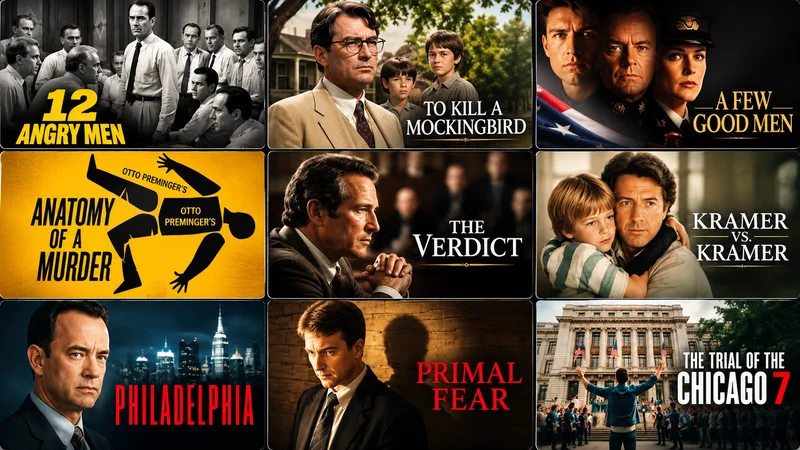
The best legal drama movies often reveal whose voices the justice system welcomes and whose it overlooks. These films address discrimination, social inequality, and the difference between a formal legal right and meaningful access to justice.
25. Court (2014)
- Director: Chaitanya Tamhane
- Style: Marathi-language Indian judicial satire
- Key highlight: A folk singer is charged over a worker’s death
Folk singer Narayan Kamble is accused of encouraging a sanitation worker’s suicide through one of his songs. The case winds through a Mumbai court, while the film also follows the ordinary lives of defense and prosecution lawyers. Vira Sathidar plays Kamble in an unusually observational portrait of the legal system.
Instead of announcing a single villain, the film studies delays, class differences, and procedures that continue regardless of the defendant’s vulnerability. Its understated pace may surprise viewers expecting a Hollywood confrontation. Choose it for a deeply original look at law as everyday bureaucracy.
26. Pink (2016)
- Director: Aniruddha Roy Chowdhury
- Style: Hindi-language consent and criminal-law drama
- Key highlight: Three women face a court battle after a disturbing encounter
After an evening involving several young men becomes frightening, three women face criminal accusations and damaging public judgments. Taapsee Pannu plays Minal, while Amitabh Bachchan portrays a retired lawyer who agrees to help. The court hearings examine how assumptions about women’s behavior can distort the treatment of consent.
The story is direct in its argument that consent cannot be inferred from clothing, social habits, or previous relationships. It includes threatening behavior and discussion of sexual violence, making it unsuitable for casual family viewing. Choose it for urgent social concerns and a memorable courtroom defense.
27. The Insult (2017)
- Director: Ziad Doueiri
- Style: Lebanese civil-dispute courtroom drama
- Key highlight: A neighborhood argument escalates into a national controversy
A dispute between Tony, a Lebanese Christian mechanic, and Yasser, a Palestinian construction worker, begins with a minor disagreement and grows into a legal battle. Adel Karam and Kamel El Basha play men whose personal pride becomes entangled with historical grievances. The courtroom exposes the political meanings attached to their words.
The film is compelling because a seemingly small civil conflict becomes inseparable from the memories of entire communities. Its perspectives are contested rather than neutral, and the social context deserves attention. Choose it for international legal cinema that turns speech and historical hurt into dramatic stakes.
28. Marshall (2017)
- Director: Reginald Hudlin
- Style: Historical civil-rights courtroom drama
- Key highlight: A young Thurgood Marshall teams up with an inexperienced local attorney
Working for the NAACP, Thurgood Marshall travels to Connecticut to defend Joseph Spell, a Black chauffeur accused of sexual assault and attempted murder. Chadwick Boseman plays Marshall and Josh Gad portrays Sam Friedman, a local lawyer drawn into a difficult collaboration. Procedural restrictions force the two men to rethink how they present their defense.
The film emphasizes legal teamwork under racial prejudice rather than treating history as a parade of victories. Its focus on a Black defendant and barriers to justice also makes our best black drama movies collection a useful next read for audiences interested in related themes. Expect mature allegations and intense testimony.
29. On the Basis of Sex (2018)
- Director: Mimi Leder
- Style: Biographical equality-law drama
- Key highlight: A young Ruth Bader Ginsburg challenges sex discrimination in court
Felicity Jones portrays Ruth Bader Ginsburg as she confronts professional barriers and seeks a legal case capable of challenging discriminatory treatment. Armie Hammer plays her husband Martin, who shares her commitment to the work. A tax dispute involving a male caregiver becomes a way to question assumptions embedded in federal law.
The film makes an abstract constitutional principle accessible through family life and courtroom preparation. As a biographical drama, it condenses legal history into a character story. Choose it for a relatively approachable introduction to strategic litigation and gender equality.
30. Just Mercy (2019)
- Director: Destin Daniel Cretton
- Style: Wrongful-conviction and civil-rights drama
- Key highlight: Bryan Stevenson fights for an Alabama death-row prisoner
Michael B. Jordan portrays attorney Bryan Stevenson, who moves to Alabama to provide representation to people facing severe injustice. His work with Walter McMillian, played by Jamie Foxx, becomes central to the film as disturbing weaknesses in the conviction emerge. Brie Larson plays advocate Eva Ansley, an important ally in the legal effort.
Based on Stevenson’s memoir and real advocacy, the film shows how racial discrimination and limited access to defense resources can shape criminal outcomes. It contains disturbing execution-related material and discussions of violence. Choose it for a compassionate legal drama that makes the human cost of wrongful conviction impossible to ignore.
31. Dark Waters (2019)
- Director: Todd Haynes
- Style: Environmental corporate-litigation drama
- Key highlight: A corporate attorney investigates chemical contamination
Robert Bilott is a lawyer who typically represents major companies, but a farmer’s complaint prompts him to investigate possible toxic contamination linked to a powerful manufacturer. Mark Ruffalo plays Bilott, whose professional and family life are strained as the research expands. Anne Hathaway and Tim Robbins appear in the supporting cast.
The film makes document review, science, and persistence feel suspenseful, showing why public-interest cases can take years of work. It is inspired by real litigation but simplifies a complex history. Choose it if you want a legal drama focused on environmental harm rather than criminal trials.
32. The Trial of the Chicago 7 (2020)
- Director: Aaron Sorkin
- Style: Political protest and federal trial drama
- Key highlight: Antiwar activists face charges after the 1968 Chicago protests
Seven defendants are tried over events surrounding protests at the Democratic National Convention in Chicago. Sacha Baron Cohen, Eddie Redmayne, Yahya Abdul-Mateen II, and an ensemble cast portray organizers and participants whose different strategies create tension inside and outside the courtroom.
The film moves quickly between testimony, political disagreement, and the conduct of the presiding court. It dramatizes historical events with compressed scenes and dialogue rather than presenting a complete record. Choose it for energetic courtroom storytelling about dissent, authority, and civil liberties.
International Courtroom Stories and Recent Legal Thrillers
The best legal drama movies extend well beyond Hollywood, and recent American mysteries add fresh ethical questions. These eight films span different legal cultures and modern concerns. Their styles range from restrained observation to fast-moving historical prosecution and suspense.
33. The Mauritanian (2021)
- Director: Kevin Macdonald
- Style: Guantanamo detention and habeas-corpus drama
- Key highlight: Attorneys challenge the detention of a man held without charge
Tahar Rahim portrays Mohamedou Ould Slahi, a Mauritanian man detained at Guantanamo Bay without a criminal charge for years. Jodie Foster plays attorney Nancy Hollander, while Shailene Woodley and Benedict Cumberbatch portray legal figures confronting different aspects of the case. The story follows the effort to obtain evidence and test the detention through the courts.
It includes deeply disturbing scenes of interrogation and torture. The legal process is shown as slow and difficult, with human rights questions extending far beyond a conventional verdict. Choose it for a serious fact-inspired examination of detention, due process, and national security.
34. Jai Bhim (2021)
- Director: T. J. Gnanavel
- Style: Tamil-language custodial-justice drama
- Key highlight: A human-rights lawyer seeks answers after a man disappears in custody
When a man from a marginalized Indigenous community is arrested and later goes missing, his wife seeks help from an attorney willing to confront police accounts of what happened. Suriya portrays lawyer Chandru, and Lijomol Jose plays Sengeni, whose determination drives the demand for answers.
The film draws on real legal activism while dramatizing the people and events involved. Its descriptions of caste discrimination, custodial brutality, and police violence are intense. Choose it for a Tamil legal drama that centers a family’s fight for recognition and accountability.
35. Argentina, 1985 (2022)
- Director: Santiago Mitre
- Style: Spanish-language historical prosecution drama
- Key highlight: Prosecutors take on leaders of Argentina’s former dictatorship
Following Argentina’s return to democracy, prosecutor Julio Strassera and his young team pursue a case against military leaders accused of grave human-rights abuses. Ricardo Darín portrays Strassera, with Peter Lanzani as fellow prosecutor Luis Moreno Ocampo. The courtroom must hear accounts of repression that powerful people would prefer to keep hidden.
The film uses elements of an underdog procedural while respecting the seriousness of the testimony. It depicts a historic accountability effort, though dramatic scenes and timelines are shaped for cinema. Choose it for a moving international story about the legal process confronting state violence.
36. Saint Omer (2022)
- Director: Alice Diop
- Style: French-language motherhood and courtroom drama
- Key highlight: A novelist attends a trial that unsettles her view of identity
Rama, a writer preparing a project about an unsettling case, attends the trial of Laurence Coly, a woman accused of killing her infant daughter. Kayije Kagame plays Rama and Guslagie Malanda portrays Laurence. Much of the film observes testimony and the silent reactions of people listening.
Diop’s restrained filmmaking shifts attention away from sensational questions toward motherhood, migration, and the difficulty of understanding another person. The case involves the death of a child and is emotionally demanding. Choose it for introspective courtroom cinema that refuses simplistic conclusions.
37. Anatomy of a Fall (2023)
- Director: Justine Triet
- Style: French courtroom and marital mystery
- Key highlight: A novelist stands trial after her husband dies at their home
Sandra Hüller plays Sandra, a writer accused of involvement in her husband’s death after he is found below their mountain home. Her visually impaired son becomes an important figure as conflicting accounts of the family’s life emerge in court. Much of the proceeding focuses on what private recordings and memories can actually establish.
The movie is less interested in a comforting answer than in how a marriage can be reshaped by public scrutiny. Its multilingual dialogue and detailed examination create unusual intimacy. Choose it for a modern courtroom mystery where certainty remains elusive until the very end.
38. The Burial (2023)
- Director: Maggie Betts
- Style: Civil business lawsuit and inspirational drama
- Key highlight: A funeral-home owner hires a flamboyant trial lawyer
Jeremiah O’Keefe faces a serious financial threat after a business arrangement with a large funeral-industry company goes wrong. Tommy Lee Jones plays Jeremiah, who hires charismatic lawyer Willie E. Gary, portrayed by Jamie Foxx, to pursue the dispute in court. Jurnee Smollett plays a formidable opposing attorney.
The legal battle is engaging because contract and corporate power become deeply personal to a family business. Based on real events, the film also examines racial inequality within the industry and legal system. Choose it for a more crowd-pleasing mix of trial strategy, humor, and principled advocacy.
39. The Caine Mutiny Court-Martial (2023)
- Director: William Friedkin
- Style: Naval military-law chamber drama
- Key highlight: An officer is prosecuted after taking command of a ship
After Lieutenant Maryk assumes command during a dangerous storm, a naval court-martial examines whether his decision was justified. Jake Lacy plays Maryk, Jason Clarke portrays defense attorney Barney Greenwald, and Kiefer Sutherland plays the ship’s captain, Queeg. The hearing turns on leadership, credibility, and the difference between insubordination and duty.
Friedkin uses the concentrated setting to make every change in testimony consequential. This adaptation of Herman Wouk’s work offers little spectacle outside its military-legal argument, but that focus makes it compelling. Choose it if you enjoy close analysis of evidence and conflicting interpretations of command.
40. Juror #2 (2024)
- Director: Clint Eastwood
- Style: Jury-duty ethical thriller
- Key highlight: A juror may possess information that changes a murder trial
Nicholas Hoult plays Justin Kemp, a family man selected for a murder jury who begins to suspect that his own past actions could be relevant to the defendant’s case. Toni Collette plays the prosecutor, while the deliberations force Justin to consider the consequences of speaking or remaining silent.
The film shifts attention from the lawyers to a citizen whose ethical responsibility is suddenly painfully personal. Its mystery is compelling without revealing the eventual legal outcome, and its dilemmas encourage discussion afterward. Choose it for a recent, accessible courtroom thriller about conscience and reasonable doubt.
Which Legal Drama Movies Will You Enjoy Most?
The best legal drama movies depend on how you prefer suspense to work. For a close study of evidence and argument, start with 12 Angry Men, Anatomy of a Murder, or The Verdict. If you enjoy sharp exchanges and a well-defined opponent, A Few Good Men and The Caine Mutiny Court-Martial make compelling selections. My Cousin Vinny offers a lighter change of mood while still respecting the importance of witness testimony.
Viewers interested in civil rights and systemic injustice can explore To Kill a Mockingbird, Marshall, Just Mercy, Jai Bhim, Pink, or The Trial of the Chicago 7. Those stories involve discrimination and some disturbing events, so the historical and emotional context matters. For cases that affect livelihoods and communities, Erin Brockovich, Dark Waters, North Country, and The Burial show how lawsuits can extend far beyond a single plaintiff.
If you want international perspectives, Court, The Insult, Argentina, 1985, Saint Omer, and Anatomy of a Fall demonstrate how dramatically legal systems and storytelling styles can differ. For psychological suspense, choose Primal Fear, Presumed Innocent, The Lincoln Lawyer, or Juror #2. Remember that cinematic courtroom speeches, compressed timelines, and dramatic surprises are storytelling choices, not reliable guides to how every real trial works.
Frequently Asked Questions
What are the best legal drama movies to watch first?
12 Angry Men, To Kill a Mockingbird, A Few Good Men, The Verdict, and Anatomy of a Fall are strong starting points. They cover juries, criminal defense, institutional ethics, and modern evidence disputes, with substantially different tones.
What is the difference between a legal drama and a courtroom thriller?
A legal drama makes the law or justice system central to the story, even when much of the action occurs outside a courtroom. A courtroom thriller usually emphasizes suspense surrounding testimony, contested evidence, and a trial outcome. Michael Clayton is largely a legal thriller outside court, while 12 Angry Men is about jury deliberation.
Which legal dramas are based on real events?
Just Mercy, Marshall, Erin Brockovich, Dark Waters, Argentina, 1985, and The Burial draw on real legal stories. In the Name of the Father and Jai Bhim also take inspiration from historical cases. They are dramatizations, so consult reliable historical or legal records before treating scenes as exact fact.
Are there excellent international courtroom movies?
Yes. India’s Court, Pink, and Jai Bhim; Lebanon’s The Insult; Argentina, 1985; and the French films Saint Omer and Anatomy of a Fall offer perspectives beyond American courtroom traditions. Their legal procedures, themes, and pacing vary considerably.
Which legal drama movies are suitable for a lighter movie night?
My Cousin Vinny and The Burial include substantial humor, though both contain adult language or serious issues. On the Basis of Sex is comparatively approachable and inspirational. Most other selections involve murder, assault, discrimination, or political violence, so check content guidance before watching with younger audiences.
Final Thoughts
The best legal drama movies remind us that a verdict is only part of a larger story about people, institutions, and the difficult search for truth. From the concentrated jury-room tension of 12 Angry Men to the international questions of Argentina, 1985 and the personal uncertainty of Juror #2, these 40 films show how many different ways cinema can approach justice. Choose a title according to the case, the moral questions, and your preferred intensity, then allow the arguments to challenge your first impressions.