

The best classic comedy movies prove that a perfectly timed mistake, an impossible romance, or an unforgettable facial expression can still make audiences laugh decades later. Silent-era clowns built elaborate jokes without dialogue, Hollywood’s fast-talking stars turned arguments into entertainment, and later filmmakers pushed satire into wonderfully outrageous territory. These movies are not all alike, and that variety is exactly what makes exploring them so rewarding.
For readers discovering films through NetShort, this Top 35 collection offers a journey from Charlie Chaplin and Buster Keaton to Marilyn Monroe, Peter Sellers, Mel Brooks, and Eddie Murphy. It includes American landmarks, British crime comedies, and a French visual masterpiece, with each selection chosen for its distinctive comic style and lasting appeal.
Here, classic means established films from earlier generations, with the selections spanning 1921 through 1988. Some are silent, some are black and white, and others include mature themes or dated attitudes that deserve context. The numbered entries are a curated viewing route rather than an official ranking. Start with whichever style sounds inviting, and use the short highlights below each movie to find a good fit.
Why Are These Classic Comedy Movies Still Worth Watching?
The best classic comedy movies do more than preserve old jokes. They show how filmmakers developed physical humor, romantic banter, parody, and social satire that later generations continued to reinvent. You can approach them through five especially rewarding qualities:
- Visual storytelling: Silent performers use movement, framing, and carefully staged mishaps to make humor understandable without spoken dialogue.
- Rapid-fire conversations: Screwball romances transform misunderstandings, competing personalities, and verbal battles into comic momentum.
- Sharp social observations: Satire finds absurdity in wealth, politics, war, work, and the rules people insist on following.
- Inventive performances: Chaplin, Keaton, the Marx Brothers, Cary Grant, and later comic stars bring unmistakable personalities to the screen.
- Different moods: Choose something tender, romantic, anarchic, darkly funny, or spectacularly silly according to your taste.
Silent-Era Comedy and Early Masters of Physical Humor
Before sharp dialogue became essential to movie comedy, performers could make a face, a doorway, or a moving train into the center of an elaborate gag. These seven silent-era and early sound-era milestones reveal just how much careful timing matters.
1. The Kid (1921)
- Director: Charlie Chaplin
- Style: Silent comedy-drama
- Key highlight: The Tramp becomes an unlikely guardian
Chaplin’s Tramp discovers an abandoned baby and raises him in a modest home, developing a partnership that is equal parts funny and moving. Jackie Coogan plays the child, whose quick reactions give Chaplin a partner rather than a passive side character. Their inventive schemes help them navigate poverty and the threat of separation.
It is a wonderful introduction to early cinema because the emotions are immediately legible. Watch for the way a small domestic gag can become a moment of affection. The film is shorter and more sentimental than many later comedies, making it especially approachable for first-time silent-film viewers.
2. Sherlock Jr. (1924)
- Director: Buster Keaton
- Style: Silent detective fantasy
- Key highlight: A projectionist enters the movie screen
Keaton plays a projectionist who dreams of becoming a detective and imagines himself inside a mystery unfolding on screen. Reality, fantasy, and movie editing become part of a dazzling comic puzzle. The film is compact, inventive, and full of precisely staged physical surprises.
Its famous sequence involving sudden changes of cinematic location still demonstrates how adventurous silent filmmakers could be. Choose it if you want brisk pacing and visual creativity rather than a sprawling plot. It also makes a delightful introduction to jokes about movies themselves.
3. The Gold Rush (1925)
- Director: Charlie Chaplin
- Style: Silent adventure comedy
- Key highlight: Hunger and loneliness become unforgettable gags
The Little Tramp heads into the Klondike hoping to find gold but faces harsh weather, scarce food, and complicated feelings for a young woman. Chaplin finds comedy in a precarious cabin and an extraordinary meal made from an unlikely object, yet the character’s wish for companionship keeps the story emotionally grounded.
Its mixture of physical precision and melancholy shows why Chaplin’s work lasts. Some moments have become iconic through imitation, but their original staging remains impressive. Choose it for a classic that combines spectacle with a surprisingly vulnerable central figure.
4. The General (1926)
- Director: Buster Keaton and Clyde Bruckman
- Style: Silent train-chase comedy
- Key highlight: Elaborate stunts built around a locomotive
During the American Civil War, railroad engineer Johnnie Gray sets out to recover a stolen train and rescue the woman he loves. Keaton uses the moving locomotive as both a stage for intricate visual jokes and the engine of an action adventure. His expressions barely change even when the situation becomes impossibly dangerous.
The scale of the practical stunt work remains startling, and the comedic tension depends on tiny errors multiplying at high speed. The wartime setting reflects a particular historical perspective rather than offering a comprehensive account of the conflict. Choose it for technical daring and deadpan physical comedy.
5. City Lights (1931)
- Director: Charlie Chaplin
- Style: Romantic silent comedy-drama
- Key highlight: The Tramp tries to help a blind flower seller
Chaplin’s familiar Tramp falls for a blind flower seller who mistakes him for a wealthy man. His attempts to earn money for her lead through odd jobs and a friendship with an eccentric millionaire. Made after sound films had become dominant, the movie relies on expressive pantomime and music rather than conventional dialogue.
The ending is renowned for emotional restraint, so it is best experienced without further spoilers. Much of the humor grows from differences between appearances and intentions. Choose City Lights when you want laughter with a genuinely tender romantic center.
6. Duck Soup (1933)
- Director: Leo McCarey
- Style: Political farce and musical comedy
- Key highlight: The Marx Brothers mock national leadership
Groucho Marx plays Rufus T. Firefly, an absurd leader who turns the affairs of a fictional country into a succession of insults, misunderstandings, and escalating conflict. Chico, Harpo, and Zeppo Marx join the chaos, with several sequences abandoning ordinary logic in pursuit of the next joke.
The famous mirror routine proves that visual comedy remained powerful even in the sound era. Its jokes are anarchic rather than warm, and the political satire is rarely subtle. Choose it when you want verbal wit, absurdity, and a film that cheerfully mocks authority.
7. Modern Times (1936)
- Director: Charlie Chaplin
- Style: Industrial satire and physical comedy
- Key highlight: Factory machinery overwhelms the worker
The Tramp struggles to keep pace with an assembly line, then encounters unemployment, confinement, and an equally determined young woman played by Paulette Goddard. Chaplin uses nearly silent storytelling, selective sound effects, and mechanical spectacle to satirize industrial labor and the pressure to be efficient.
Its central idea is remarkably easy to recognize: systems built to increase productivity can forget the people inside them. The film’s social concerns never overwhelm its inventive set pieces. Choose it for physical humor that also has something urgent to say about work and dignity.
Hollywood Screwball Comedies and British Wit From the 1930s and 1940s
When dialogue became central, filmmakers transformed arguments into an art form. Romantic rivals, ambitious reporters, and polite-looking criminals populate some of the best classic comedy movies of the studio era. Expect fast exchanges, playful deception, and occasionally very dark humor.
8. Bringing Up Baby (1938)
- Director: Howard Hawks
- Style: Screwball romantic comedy
- Key highlight: Cary Grant, Katharine Hepburn, and a leopard
Cary Grant plays a tightly wound paleontologist whose carefully planned wedding and museum work unravel when he meets Susan Vance, played by Katharine Hepburn. Susan’s impulsive decisions, an escaped leopard, and a missing dinosaur bone create increasingly tangled situations.
The pace depends on Grant’s attempts to restore order while Hepburn seems to generate chaos simply by being present. Choose this if you love romantic comedy built on clashing temperaments rather than solemn declarations. Its energy remains extraordinary.
9. His Girl Friday (1940)
- Director: Howard Hawks
- Style: Newspaper screwball comedy
- Key highlight: Lightning-fast dialogue and romantic rivalry
Newspaper editor Walter Burns tries to stop his former wife and star reporter Hildy Johnson from leaving journalism and marrying another man. Cary Grant and Rosalind Russell make professional competition and lingering attraction feel inseparable as an important criminal case disrupts their plans.
Its overlapping conversations may be the fastest thing about it, and the jokes often come from people refusing to let anyone finish a sentence. Watch for an unusually strong female lead and a film whose newsroom energy influenced decades of romantic banter.
10. The Philadelphia Story (1940)
- Director: George Cukor
- Style: High-society romantic comedy
- Key highlight: A wedding threatened by old feelings
Katharine Hepburn plays Tracy Lord, a wealthy woman preparing to remarry while her ex-husband and a reporter arrive to complicate the celebration. Cary Grant and James Stewart portray men whose very different perspectives challenge Tracy’s carefully controlled image.
The film’s wit comes from the tension between social polish and emotional vulnerability. Its characters discover that appearing sophisticated is not the same as understanding someone else. Choose it if you like elegant costumes, sharp dialogue, and romances that reconsider first impressions.
11. The Lady Eve (1941)
- Director: Preston Sturges
- Style: Con-artist romantic farce
- Key highlight: Barbara Stanwyck outwits Henry Fonda
A skilled card sharp on an ocean liner sets her sights on a wealthy, awkward snake expert. Barbara Stanwyck’s Jean has a plan for Henry Fonda’s Charles, but genuine feelings interfere with her confidence. Disguises and hurt pride make the romance even more complicated after their initial encounter.
Stanwyck’s comic authority is the main attraction: she knows exactly when to tease and when to reveal her disappointment. Choose it for a sparkling battle of wits with more emotional warmth than the con-artist premise might suggest.
12. Sullivan’s Travels (1941)
- Director: Preston Sturges
- Style: Hollywood satire and road comedy
- Key highlight: A director goes searching for hardship
Joel McCrea plays a successful comedy filmmaker who decides he should create something more socially serious. He disguises himself as a poor traveler to learn about hardship but finds that his carefully organized experiment cannot account for actual uncertainty. Veronica Lake plays a woman he meets along the way.
The film offers an unusually thoughtful defense of laughter without denying that real suffering exists. Its comic reversals become more meaningful as the director’s assumptions fall apart. Choose it if you appreciate a comedy that reflects on why people need comedy.
13. To Be or Not to Be (1942)
- Director: Ernst Lubitsch
- Style: Wartime dark comedy
- Key highlight: A theater troupe outsmarts dangerous officials
In occupied Warsaw, members of a theatrical company use costumes, impersonations, and their stage experience to disrupt a Nazi intelligence operation. Jack Benny and Carole Lombard play actors whose vanity and quick thinking both affect the plan. The stakes are frightening, even when the mistaken identities become outrageous.
Its boldness lies in using comedy against authoritarian power without pretending the danger is imaginary. The jokes are brisk, but the historical context deserves respect. Choose it for sophisticated dark humor and cleverly constructed deception.
14. Arsenic and Old Lace (1944)
- Director: Frank Capra
- Style: Macabre family farce
- Key highlight: A cheerful household hides a dreadful secret
Cary Grant plays newlywed writer Mortimer Brewster, who discovers that his sweet elderly aunts have been carrying out a disturbing form of charity. His attempts to protect his relatives and keep everything from collapsing become more frantic as additional family members and visitors arrive.
The contrast between a cozy home and its gruesome secret supplies the movie’s distinctive tone. Grant’s expressions grow more desperate with every complication. Choose it for dark comedy delivered at a remarkably lively pace, with murder treated as absurd rather than realistic.
15. Kind Hearts and Coronets (1949)
- Director: Robert Hamer
- Style: British black comedy
- Key highlight: Alec Guinness plays multiple aristocrats
Louis Mazzini believes a noble title should belong to him and devises a ruthless plan to remove the relatives standing in his way. Dennis Price plays Louis, whose polished narration makes his ambition even more unsettling, while Alec Guinness portrays the various members of the titled family.
This Ealing Studios classic is funny because its central character describes appalling behavior with complete elegance. The precision of the satire makes it a different experience from American screwball romances. Choose it for dry British wit, ingenious performances, and a very dark sense of humor.
Midcentury Comedies: Musicals, Crime Capers, Romance, and Satire
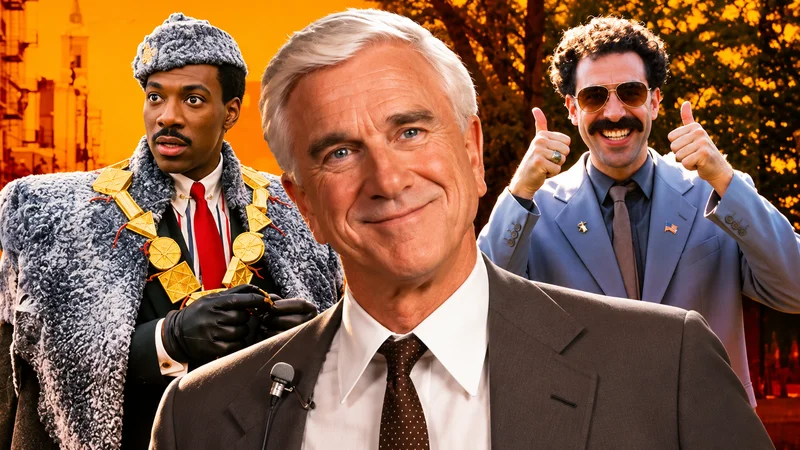
The 1950s and 1960s brought musical spectacle, complex social satire, and some of the most influential romantic farces. Several of the best classic comedy movies in this period mix laughter with moral questions, showing that a great comedy does not need to stay lightweight.
16. Singin’ in the Rain (1952)
- Director: Gene Kelly and Stanley Donen
- Style: Musical comedy
- Key highlight: Hollywood’s transition to talking pictures
Silent-film star Don Lockwood faces a professional crisis when sound transforms the movie industry and his glamorous costar proves difficult to record. Gene Kelly, Debbie Reynolds, and Donald O’Connor turn the technical upheaval into an exuberant collection of songs, dances, and backstage rivalries.
It is a comedy about show business that also demonstrates what cinema can accomplish through movement and rhythm. O’Connor’s physical performance and Kelly’s joyful dancing are enduring attractions. Choose it for an uplifting introduction to classic musicals, even if you do not usually seek them out.
17. Roman Holiday (1953)
- Director: William Wyler
- Style: Romantic comedy
- Key highlight: Audrey Hepburn explores Rome incognito
A European princess escapes her rigid schedule and spends an extraordinary day exploring Rome with an American reporter who recognizes her. Audrey Hepburn brings warmth and curiosity to the princess, while Gregory Peck makes the journalist’s conflict between opportunity and affection surprisingly moving.
The Roman locations lend the film the feeling of a spontaneous holiday, even as the situation becomes emotionally complicated. It is gentler than many joke-heavy classics. Choose it for charm, a lovely central pairing, and a romantic story that respects its characters’ responsibilities.
18. The Ladykillers (1955)
- Director: Alexander Mackendrick
- Style: British crime comedy
- Key highlight: Criminals pretend to be musicians
A group of thieves rents rooms from elderly Mrs. Wilberforce while pretending to practice chamber music. Alec Guinness leads the criminals, with Katie Johnson giving the seemingly harmless landlady an extraordinary presence. The robbery becomes less manageable as the men discover that their host is not as easily manipulated as they expected.
The contrast between genteel surroundings and criminal intention makes this a perfect bridge between the best classic comedy movies and our best british crime movies collection. Choose the 1955 original for its dry humor, precise performances, and clever reversal of who really holds the power.
19. Some Like It Hot (1959)
- Director: Billy Wilder
- Style: Disguise and romantic farce
- Key highlight: Two musicians hide in an all-women band
After witnessing a mob killing, Chicago musicians Joe and Jerry flee disguised as women and join a traveling band. Tony Curtis and Jack Lemmon become increasingly entangled in romantic and criminal complications, with Marilyn Monroe playing singer Sugar Kane.
The premise allows Wilder to build one misunderstanding on top of another without losing the stakes. Lemmon’s escalating improvisations are especially funny, while the final exchange has become famous for good reason. Choose it for rapid timing and a remarkably durable comic setup.
20. The Apartment (1960)
- Director: Billy Wilder
- Style: Romantic comedy-drama
- Key highlight: A clerk lends his apartment to executives
Jack Lemmon plays C.C. Baxter, an office worker who hopes to advance by letting company superiors use his apartment for affairs. His arrangement becomes unbearable when he realizes that the woman he cares about is caught in the same dishonest system. Shirley MacLaine plays Fran Kubelik with wit and vulnerability.
The film’s workplace observations are funny, but the underlying loneliness makes it more mature than a typical romantic farce. Choose it for layered performances and an ending whose emotional power comes from two people learning to respect themselves.
21. The Pink Panther (1963)
- Director: Blake Edwards
- Style: Jewel-heist romantic farce
- Key highlight: Peter Sellers introduces Inspector Clouseau
Inspector Jacques Clouseau becomes involved in a mystery surrounding a valuable diamond while a charming thief and several romantic entanglements complicate the case. Peter Sellers makes the accident-prone detective memorable, with David Niven and Claudia Cardinale helping establish its glamorous European setting.
This first film is more of an ensemble caper than the later, more Clouseau-focused entries. Its elegance and playful score are part of its charm. Choose it if you enjoy mistaken identities, jewel thieves, and comedy that emerges from a detective’s spectacular lack of self-awareness.
22. Dr. Strangelove (1964)
- Director: Stanley Kubrick
- Style: Political black comedy
- Key highlight: Peter Sellers plays three roles
A deranged military order places the United States and Soviet Union on the brink of nuclear catastrophe. Government officials attempt to prevent disaster through conversations that grow more ridiculous as the danger intensifies. Peter Sellers portrays several contrasting figures, while George C. Scott adds an unforgettable performance as an excitable general.
The subject could hardly be darker, yet Kubrick makes bureaucratic certainty and military pride absurdly funny. It is not a comforting film, and its Cold War context helps explain the jokes. Choose it for fearless satire that still provokes uncomfortable laughter.
23. PlayTime (1967)
- Director: Jacques Tati
- Style: French visual and architectural comedy
- Key highlight: Monsieur Hulot navigates modern Paris
Jacques Tati’s Monsieur Hulot wanders through a glass-and-steel city of offices, showrooms, and restaurants, while countless small comic situations unfold around him. Much of the humor takes place in the background or depends on the geometry of a crowded room rather than a conventional plot.
PlayTime rewards patient attention because there may be three jokes happening at once. Its sophisticated sound design adds another layer to the physical comedy. Choose it if you are curious about international cinema and want to discover how a wide shot can become an entire comic universe.
24. The Producers (1967)
- Director: Mel Brooks
- Style: Show-business satire
- Key highlight: A deliberately terrible musical becomes a problem
Broadway producer Max Bialystock and accountant Leo Bloom discover that an enormous financial scheme might succeed if they create a theatrical failure. Zero Mostel and Gene Wilder play the partners, whose terrible taste and greed lead them toward an outrageous stage production.
The premise attacks opportunism and show-business vanity through deliberately offensive theatrical satire. It includes material about Nazism that is presented as ridicule, not endorsement, and may not suit every audience. Choose it for Brooks’s daring and the beautifully mismatched energy of its leads.
1970s Comedies That Redefined Romance, Parody, and Rebellion
By the 1970s, filmmakers could experiment more openly with taboo subjects, irreverent characters, and jokes that challenged familiar genres. These films broadened the range of the best classic comedy movies, though several require awareness of their dated or provocative content.
25. Harold and Maude (1971)
- Director: Hal Ashby
- Style: Unconventional romantic black comedy
- Key highlight: An unlikely friendship transforms a young man’s outlook
Harold, a wealthy young man fascinated by death, befriends Maude, an older woman whose love of life challenges his gloomy habits. Bud Cort and Ruth Gordon give their unusual relationship a mixture of absurdity, tenderness, and provocative humor.
The movie treats mortality and age differences in ways that were unusual for mainstream comedy, and some depictions of death may be difficult for viewers. Choose it when you want a gentle but eccentric film that asks why people should live on their own terms.
26. Young Frankenstein (1974)
- Director: Mel Brooks
- Style: Horror-film parody
- Key highlight: Gene Wilder revives a family experiment
Dr. Frederick Frankenstein reluctantly visits his ancestral castle and discovers that his family’s scientific ambitions are difficult to ignore. Gene Wilder plays the doctor, alongside Marty Feldman, Teri Garr, and Peter Boyle. Brooks recreates the atmosphere of vintage monster movies in black and white.
Its production style is part of the joke, with dramatic lighting and serious performances used to support absurd situations. Choose it for a loving spoof that works whether you know the old Universal horror films or simply enjoy elaborate comic timing.
27. Blazing Saddles (1974)
- Director: Mel Brooks
- Style: Western satire
- Key highlight: A new sheriff confronts a corrupt town
Cleavon Little plays Bart, appointed sheriff of a frontier town as part of a scheme to drive out its residents. Gene Wilder plays the Waco Kid, an unlikely ally who sees through the community’s hypocrisy. Brooks combines Western parody with pointed jokes about racism and powerful people.
The film uses racial slurs and deliberately offensive material to attack bigotry, so context matters. Its anarchic ending also breaks many storytelling rules. Choose it for fearless genre parody if you are comfortable with challenging and historically specific satire.
28. Monty Python and the Holy Grail (1975)
- Director: Terry Gilliam and Terry Jones
- Style: Medieval absurdist comedy
- Key highlight: King Arthur’s quest goes spectacularly wrong
Members of Monty Python portray Arthur, his knights, and an array of peculiar figures encountered during the search for the Holy Grail. Instead of heroic battles, the journey produces arguments about politics, impossible creatures, and jokes that interrupt the adventure itself.
The comedy is proudly nonsensical, mixing wordplay, physical gags, and deliberate anticlimax. Its low-budget ingenuity has become part of its appeal. Choose it if you enjoy British absurdism and are happy for a movie to mock its own plot.
29. The Jerk (1979)
- Director: Carl Reiner
- Style: Absurdist rags-to-riches comedy
- Key highlight: Steve Martin’s impossibly naive Navin
Steve Martin plays Navin Johnson, a naive man who leaves home to make his fortune and repeatedly misunderstands the world around him. His journey through odd jobs, romance, and accidental success becomes a series of escalating comic misadventures.
The film is built around Martin’s distinctive blend of innocence and foolish confidence. Some racial jokes and characterizations have aged poorly, and viewers should approach them with context. Choose it for surreal setups and a performance that helped establish Martin’s screen-comedy persona.
1980s Comedy Hits That Became Modern Classics
The final six films extend the tradition into high-concept parody, romantic identity games, workplace rivalry, and supernatural adventure. These best classic comedy movies from the 1980s show how older comic forms could be rebuilt for bigger, faster studio entertainment.
30. Airplane! (1980)
- Director: Jim Abrahams, David Zucker, and Jerry Zucker
- Style: Disaster-film parody
- Key highlight: Leslie Nielsen’s completely straight-faced delivery
A former pilot boards a troubled flight in hopes of winning back a flight attendant, only to face a medical emergency and increasingly absurd complications. Robert Hays and Julie Hagerty play the romantic leads, while Leslie Nielsen helps turn apparent seriousness into a source of relentless jokes.
Almost every visual detail can hide a punch line, so it rewards watching more than once. Some gags reflect attitudes that have changed since 1980. Choose it if you want a fast, unapologetically silly introduction to modern spoof comedy.
31. Tootsie (1982)
- Director: Sydney Pollack
- Style: Disguise and workplace romantic comedy
- Key highlight: Dustin Hoffman plays an actor inventing a new persona
Michael Dorsey is a talented but difficult actor who disguises himself as Dorothy Michaels to secure a role on a television soap opera. Dustin Hoffman gives both sides of the character an energetic comic personality, while Jessica Lange plays a colleague whose friendship complicates his deception.
Its humor grows from Michael being forced to experience a workplace differently from how he once understood it. Some gender-related assumptions show the film’s age, but its performances remain fascinating. Choose it for sharp character comedy and the consequences of one ambitious lie.
32. Trading Places (1983)
- Director: John Landis
- Style: Social satire and buddy comedy
- Key highlight: Eddie Murphy and Dan Aykroyd swap circumstances
Two wealthy investors engineer a cruel experiment involving a privileged businessman and a street hustler, deliberately reversing their social positions. Dan Aykroyd and Eddie Murphy play the men who discover the wager and begin to understand who is truly controlling their lives.
The film satirizes class and financial power through elaborate misfortune and fast-talking performances. It contains offensive dated humor, including a notorious racist disguise sequence. Choose it for the leads’ chemistry while recognizing that not every joke remains comfortable today.
33. Ghostbusters (1984)
- Director: Ivan Reitman
- Style: Supernatural adventure comedy
- Key highlight: Scientists turn ghost hunting into a business
Three paranormal researchers start a business dealing with ghosts in New York, eventually bringing a fourth team member into the operation. Bill Murray, Dan Aykroyd, Harold Ramis, and Ernie Hudson give the group an appealing mix of cynicism, excitement, and practical determination.
The special effects and creature designs support the jokes rather than replacing them. It is a lively example of comedy and adventure sharing equal space, though some paranormal scenes may frighten young children. Choose it for memorable characters and blockbuster-sized imaginative fun.
34. Ferris Bueller’s Day Off (1986)
- Director: John Hughes
- Style: Teen rebellion and friendship comedy
- Key highlight: A school-free day across Chicago
Confident teenager Ferris Bueller persuades his girlfriend and anxious best friend to skip school for an extraordinary day out. Matthew Broderick leads the adventure, while Alan Ruck’s Cameron provides its emotional counterweight and Jeffrey Jones plays the principal determined to expose the deception.
The film is a celebration of spontaneity, yet Cameron’s struggle with self-confidence gives it a more lasting purpose. The Chicago locations and soundtrack remain part of its identity. Choose it for bright, energetic comedy that still makes room for personal growth.
35. Coming to America (1988)
- Director: John Landis
- Style: Fish-out-of-water romantic comedy
- Key highlight: Eddie Murphy’s prince looks for love in Queens
Prince Akeem leaves the comforts of the fictional kingdom of Zamunda to find a partner who values his personality rather than his status. Eddie Murphy plays Akeem, while Arsenio Hall takes on his royal companion and other supporting roles. Ordinary jobs and life in New York create comic contrasts with the prince’s upbringing.
The film blends large-scale fantasy with an approachable desire to be loved for who you are. Its vibrant supporting characters remain a major attraction. Choose it when you want an affectionate romantic comedy with memorable performances and plenty of old-school charisma.
Which Classic Comedy Style Will You Enjoy Most?
The best classic comedy movies are easier to explore when you choose a style rather than simply picking the oldest or most famous title. If you like visual storytelling, try Sherlock Jr., City Lights, or PlayTime. If fast verbal exchanges make you laugh, begin with His Girl Friday, The Lady Eve, or The Philadelphia Story. For romance with more emotion, Roman Holiday and The Apartment make excellent choices.
Fans of satire can try Modern Times, Kind Hearts and Coronets, Dr. Strangelove, and Blazing Saddles, though the darker material may require some preparation. Families interested in an accessible introduction could start with Singin’ in the Rain or Ghostbusters, checking content guidance for younger children. If you usually watch modern comedies, Airplane!, Trading Places, and Ferris Bueller’s Day Off offer familiar pacing.
Older films sometimes use stereotypes or social attitudes that audiences now question. Watching thoughtfully does not mean ignoring the humor, but it does mean recognizing historical context. Try one silent film, one screwball romance, and one satire before deciding which period speaks to you most.
Frequently Asked Questions
What are the best classic comedy movies for beginners?
Some Like It Hot, Singin’ in the Rain, Airplane!, and Bringing Up Baby are lively starting points. They showcase different approaches without requiring specialist film knowledge. For silent comedy, Sherlock Jr. is concise and packed with visual invention.
Which classic comedy movies are suitable for family viewing?
The Kid, Singin’ in the Rain, and some of Chaplin’s other films are appealing introductions for many families. Ghostbusters has supernatural scares, and some later titles contain mature humor or dated stereotypes. Check individual age guidance and the needs of the people watching.
What is the difference between silent comedy and screwball comedy?
Silent comedy primarily communicates through physical performance, images, and timing. Screwball comedy usually relies on rapid dialogue, romantic rivalry, and socially mismatched characters. Bringing Up Baby is a strong screwball example, while The General demonstrates the precision of silent physical comedy.
Are there great British classic comedy movies on this list?
Yes. Kind Hearts and Coronets, The Ladykillers, and Monty Python and the Holy Grail show very different British comic traditions. The first two use darkly elegant or criminal premises, while Monty Python favors absurdist parody.
Why do classic comedies still influence new movies?
Their basic techniques remain useful: misunderstandings create stories, contrasting personalities create conflict, and precise timing creates laughter. Modern romantic comedy, parody, and buddy adventures continue to borrow those ideas, even when the settings and social attitudes change.
Final Thoughts
The best classic comedy movies are not simply old films that people feel obliged to respect. They offer distinctive personalities, inventive cinematic techniques, and moments that remain genuinely funny. These 35 selections move from Chaplin’s tenderness and Keaton’s daring to British dark comedy, Hollywood romance, and energetic 1980s hits. Start with a style that fits your mood, then explore another era. The greatest discovery may be a film you never expected to love.